Identifying a Man-Eating Crocodile: key Signs to Look For
5/30/20263 min read
How to Identify a Man-Eating Crocodile
Understanding the Habitat of a Man-Eating Crocodile
The search for a man-eating crocodile usually begins with an understanding of its habitat. In my experience, these crocodiles are rarely found at random. Most operate within a specific stretch of river, lake, marsh, or estuary where they have learned that humans are predictable sources of food.
Particular attention should be paid to places where people regularly enter the water. Fishing sites, village bathing areas, river crossings, laundry points, and canoe landing sites are all locations where crocodile attacks commonly occur. A crocodile that repeatedly frequents such areas deserves careful observation.
Man-eaters often favour locations that provide excellent concealment. Overhanging vegetation, reed beds, undercut riverbanks, floating mats of vegetation, and deep pools allow them to approach their victims unseen. These ambush sites enable a crocodile to strike with maximum surprise and minimum effort.
The history of attacks in a particular area is often one of the most valuable clues. Crocodiles are territorial creatures and may remain within the same section of water for many years. If several attacks occur within a relatively small area, there is a strong possibility that a specific crocodile is responsible.
Understanding the habitat and attack history of an area is often the first step in narrowing down the search for a suspected man-eater.
Behavioural Traits of a Suspected Man-Eater
A crocodile’s behaviour can reveal a great deal about whether it poses a threat to humans. Most crocodiles are naturally wary and will usually avoid close contact with people whenever possible.
A suspected man-eater often behaves differently.
One of the most obvious warning signs is a lack of fear. A crocodile that remains visible when people approach, repeatedly surfaces near fishermen, or shows little concern for boats and canoes may have become accustomed to human activity.
Another danger sign is a crocodile that regularly patrols village waterfronts, bathing areas, or fishing sites. Such behaviour may indicate that the animal has learned to associate humans with food opportunities.
In some cases, villagers report seeing the same crocodile repeatedly following canoes or observing people from the water’s edge. While curiosity alone does not make a crocodile a man-eater, repeated bold behaviour should never be ignored.
Experience has shown that many confirmed man-eaters display unusual confidence around people long before an attack occurs.
The Importance of Size and Age
Although crocodiles of various sizes are capable of attacking humans, the majority of confirmed man-eaters are large adult crocodiles.
A crocodile exceeding three metres in length possesses the strength required to overpower an adult human and drag the victim into deep water. Larger specimens also have many years of hunting experience and are often more efficient predators.
Older crocodiles tend to be more patient and calculating. Having survived for decades, they learn the habits of both animals and humans. They understand where people collect water, where fishermen launch their boats, and where livestock cross rivers.
This does not mean that every large crocodile is a man-eater. Many live their entire lives without attacking a person. However, when investigating a series of attacks, large mature crocodiles naturally become the primary suspects.
The Value of Local Knowledge
Throughout my years involved in problem animal control, I learned that local knowledge is often the most valuable tool available.
Fishermen, villagers, and river users spend countless hours beside the water and frequently notice details that outsiders miss. They often know which crocodile regularly patrols a certain stretch of river, where it basks during the day, and where it disappears at night.
Many successful hunts began with information supplied by local people. Their observations helped identify patterns of movement, preferred ambush sites, and areas where attacks repeatedly occurred.
When several independent witnesses describe the same large crocodile appearing near attack sites, their information can prove invaluable.
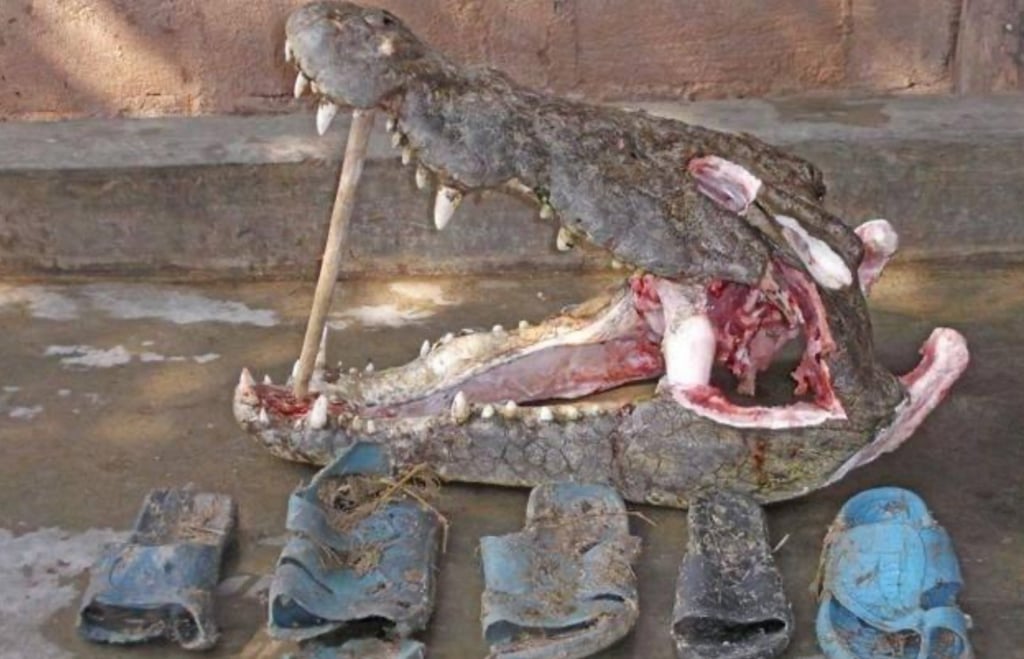
Identifying a man-eating crocodile is rarely a matter of chance. It requires patience, observation, local knowledge, and a thorough understanding of crocodile behaviour. Even then, certainty is not always possible until the crocodile has been captured or destroyed.
The river keeps its secrets well, and a true man-eater is often one of the most difficult predators in Africa to track.
The Real Crocodile Hunter®
© 2026 Ian Bartlett.
The Real Crocodile Hunter® is a registered trademark. All Rights Reserved.