The Real Crocodile Hunter's Twenty Years of Conservation
Conserving my 600 acre Forest
Ian Bartlett - The Real Crocodile Hunter
1/23/20262 min read
From Crocodiles to Canopy: My Quiet Conservation Story from Mpatamanga
For most people, my name is tied to crocodiles. Dangerous rivers. Close calls. The kind of stories that make people lean forward when you pause mid-sentence
What far fewer people know is that, for more than twenty years, another story has been unfolding quietly on the banks of the Shire River—one measured not in teeth or gunshots, but in trees that were allowed to keep growing
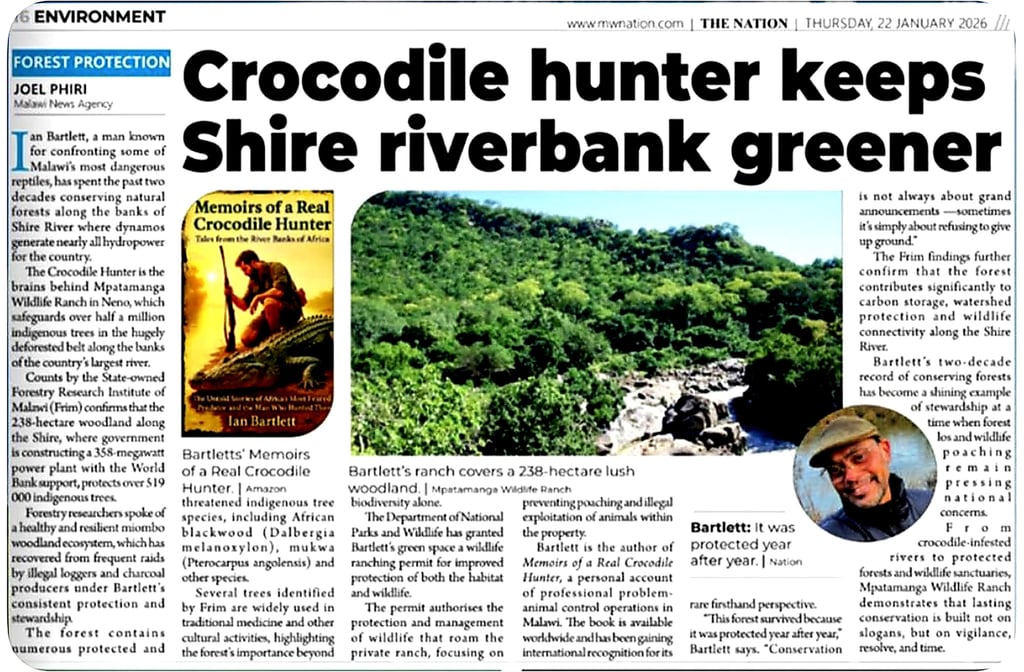
I’m writing this because a recent independent assessment finally put numbers to something I have watched happen year by year at Mpatamanga Wildlife Ranch in Malawi
According to a forest inventory conducted by the Forestry Research Institute of Malawi (FRIM), the ranch now protects more than 519,000 indigenous trees across approximately 238 hectares of woodland along the Shire River, in Neno District
I didn’t plant most of those trees
I simply refused to let them be destroyed
Holding the Line
When I first took responsibility for this land, the miombo woodland had already suffered. Charcoal burning. Illegal logging. The slow death that happens when pressure is applied year after year, and nobody pushes back.
So I did the unglamorous thing: I protected it. Consistently. Patiently. Sometimes stubbornly.
Over time, the forest responded
FRIM’s assessment describes the woodland today as healthy and resilient, with clear signs of regeneration after decades of pressure. Species like African blackwood (Dalbergia melanoxylon) and mukwa (Pterocarpus angolensis)—trees with ecological, cultural, and medicinal importance—are now firmly established. Some of these trees are used in traditional medicine, reminding us that conservation isn’t just about wildlife or carbon figures; it’s about people and continuity as well.
The forest survived because it was protected year after year
Not because of headlines
Not because of funding cycles
But because someone stayed
Wildlife Protection Without Applause
Conservation doesn’t stop at trees.
Recognising the need to protect habitat and wildlife together, I was granted a formal Wildlife Ranching Permit by the Department of National Parks and Wildlife (DNPW). That permit authorises the management and protection of wildlife on the ranch, with a particular focus on preventing poaching and illegal exploitation.
Again—nothing dramatic. Just vigilance, boundaries, and saying “no” often enough that it starts to stick.
Ironically, this quieter work runs parallel to the louder chapter of my life. The decade I spent as a licensed crocodile hunter, carrying out problem-animal control operations in some of Malawi’s most dangerous river systems. Those experiences are captured in my book, Memoirs of a Real Crocodile Hunter, which has found readers around the world
But the forest tells a different kind of story.
Why This Matters Now
FRIM’s findings also confirm what anyone who understands ecosystems would expect: this forest contributes meaningfully to carbon storage, watershed protection, and wildlife connectivity along the Shire River corridor.
At a time when deforestation and poaching remain serious national challenges, Mpatamanga stands as proof that long-term private conservation can work—without donor dependency, NGO branding, or constant supervision.
I never set out to win awards. But I do believe in accountability and evidence. And with over two decades of verifiable conservation behind it, Mpatamanga Wildlife Ranch now speaks for itself.
From crocodile-infested rivers to recovering forests, this journey has taught me one enduring lesson:
Real conservation isn’t built on slogans
It’s built on showing up, holding ground, and staying long after the noise fades.
Sometimes, the most important victories grow quietly—one season at a time.
For more information, please visit: https://mpatamangawildliferanch.com
The Real Crocodile Hunter®
© 2026 Ian Bartlett.
The Real Crocodile Hunter® is a registered trademark. All Rights Reserved.